Chanel Date Stamps: How to Read it
What are Chanel “date stamp alphabets”?
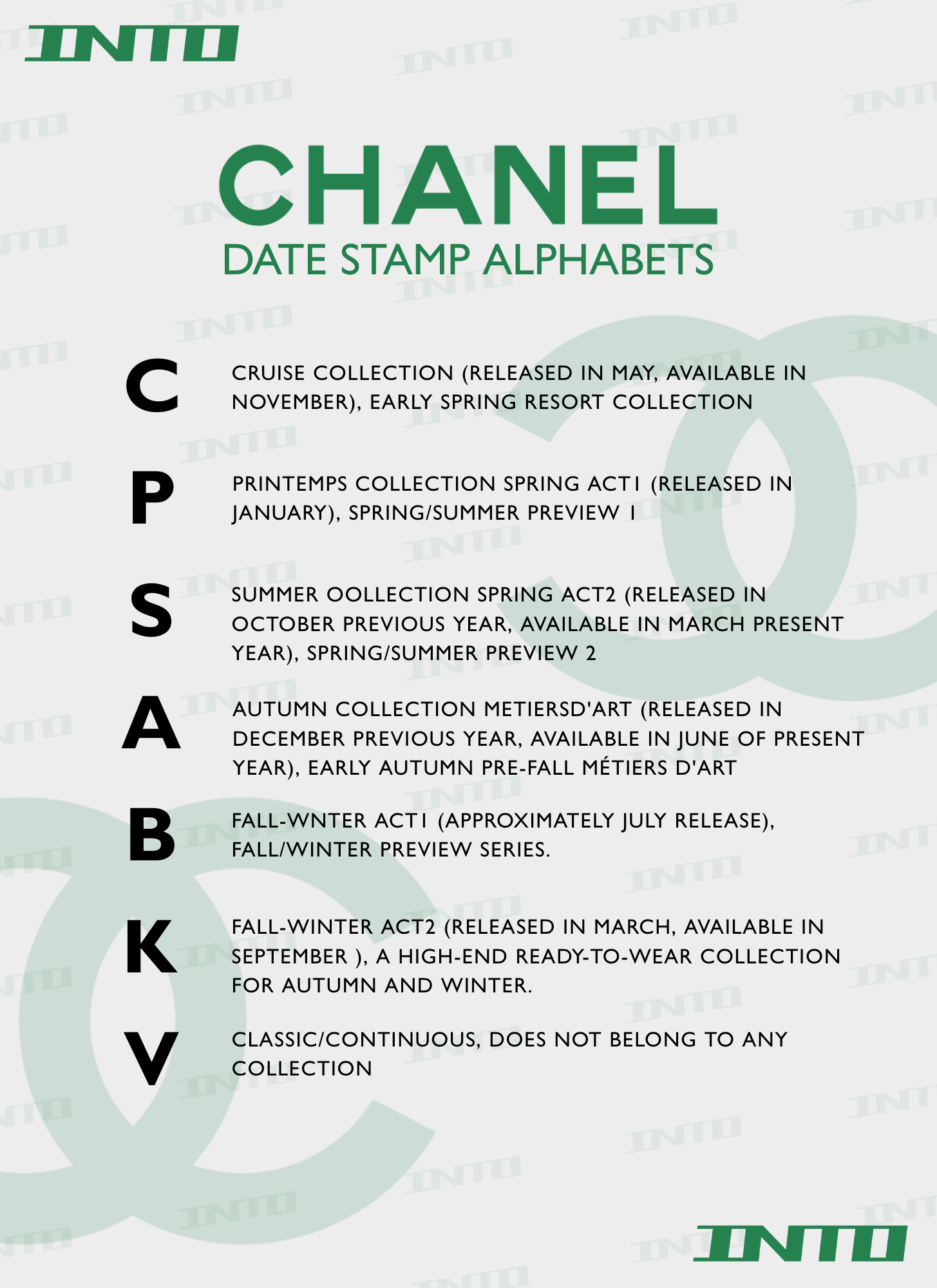
On many Chanel pieces—especially ready-to-wear, shoes, and accessories—you’ll find a single letter alongside the seasonal code. That letter isn’t random: it maps to the collection season and delivery window, helping you understand when an item was produced and which collection it belongs to. Paired with other identifiers (materials, construction details, and, where applicable, serial codes), it’s a powerful cross-check for authenticity and accurate dating.
Below, we decode each letter exactly as we use it when authenticating at Into Archive.
C — Cruise (Resort)
“C” marks Cruise/Resort: a collection previewed late fall, released around May and typically available in boutiques by November of the prior year. Think travel-ready fabrics, transitional layers, and a lighter color story leading into spring. When you see “C,” you’re likely looking at early-spring resort deliveries.
Verify like a pro: silhouettes and fabric weights should feel lighter; look for nautical or destination motifs that Chanel often sprinkles into Cruise.
P — Printemps (Spring) Act 1
“P” denotes Printemps (Spring) Act 1, i.e., the first spring delivery. It’s released in January, and functions as a Spring/Summer preview 1. Expect foundational seasonal colors, early knitwear, and transitional tailoring.
Checkpoints: early-season color cards, lightweight tweeds, and knit sets that reappear (evolved) later in the season.
S — Summer (Spring) Act 2
“S” is Summer/Spring Act 2. It’s released around October of the previous year for runway buyers and available in boutiques by March of the current year—your Spring/Summer preview 2. These deliveries bring the full warm-weather story: saturated color, airy fabrics, and statement accessories.
Tell-tale signs: raffia, sheer layering, and open-weave tweeds; ready-to-wear that pairs with SS runway accessories.
A — Autumn Métiers d’Art
“A” stands for Autumn / Métiers d’Art—Chanel’s artisanal capsule spotlighting the maison’s partner ateliers. It’s released in December of the previous year and arrives in stores by June of the current year. Expect craftsmanship: intricate embroidery, passementerie, and embellished tweeds.
Authentication angle: superb workmanship (Lesage embroidery, Lemarié feathers, Goossens metalwork). Fabric labels and interior finish should be immaculate.
B — Fall/Winter Act 1
“B” indicates Fall–Winter Act 1, generally the July delivery and often a pre-collection (FW preview series). Colors deepen; fabrics gain weight.
Checkpoints: early coats, transitional knits, and leather goods aligning with the FW runway palette that fully lands in Act 2.
K — Fall/Winter Act 2 (Main)
“K” marks Fall–Winter Act 2—the main FW collection, released in March and available in boutiques by September. This is the cold-weather statement drop: full outerwear, suiting, boots, and evening pieces.
Details to look for: heavier tweeds, quilting, shearling accents, and runway-linked accessories.
V — Classic / Continuative
“V” identifies Classic/continuous pieces that don’t belong to a specific seasonal collection. These are timeless styles Chanel keeps producing—think house-signature cuts and perennial colors.
Verification note: construction and materials should match Chanel’s classic standards; colorways are generally core (black, white, ecru, navy, red) with occasional seasonal reissues.
How to use letters for dating & authenticity
- Cross-reference the letter with the drop calendar above to place the item in the right season window.
- Pair with other codes (where relevant): style codes on tags, fabric codes, lining stamps, and for handbags/vintage SLG, the 7- or 8-digit serial era can corroborate timeframes.
- Sanity-check materials & motifs: e.g., Cruise (C) and Summer (S) skew lighter; Métiers d’Art (A) should show elevated craftsmanship; FW drops (B/K) trend heavier and richer in texture.
- Inspect quality markers: stitching density on tweeds and leather, button backs (engraving quality), zipper brands, lining consistency, and label placement.